By Analyst Team · Updated 2026-07-13 · 14 min read
If you've ever wondered how to cut your cable bill without losing access to live sports, international channels, or on-demand movies, you've probably heard of an IPTV box. This complete guide answers your most pressing questions: What exactly is it? Is it legal? How does it compare to a Firestick? And most importantly, how do you choose the right one for your needs?
We've spent hours researching hardware specs, testing streaming performance, and analyzing real user reviews to bring you an honest, no-fluff resource. Whether you're a cord-cutter, a sports fanatic, or someone looking to watch international content, this guide covers everything from setup to troubleshooting — so you can make an informed decision the first time.
Let's start with the basics and work our way up to advanced tips, pricing comparisons, and recommendations for finding the best IPTV box for your specific requirements.
What Is an IPTV Box Exactly?
An IPTV box (Internet Protocol Television box) is a small hardware device that connects to your television and streams live TV channels and on-demand content over the internet — rather than through traditional cable, satellite, or antenna signals. Think of it as a dedicated streaming computer that sits under your TV and turns any HDMI-equipped display into a fully-featured television system.
Unlike a smart TV with built-in apps, an IPTV box offers more flexibility. Most run on Android TV or Linux operating systems, allowing you to install third-party IPTV players like TiviMate, IPTV Smarters Pro, or XCIPTV. These apps then connect to an IPTV subscription service — a server that delivers hundreds or even thousands of live channels directly to your device.
Key components you'll find in any IPTV box include: a processor (CPU), RAM (usually 2GB to 4GB), internal storage (8GB to 64GB), Wi-Fi and Ethernet connectivity, and HDMI output. Higher-end models support 4K resolution, HDR10+, Dolby Audio, and even voice control via remote.
How an IPTV Box Works Step by Step
Understanding the technology behind IPTV doesn't require a computer science degree. The process is surprisingly straightforward and follows this logical sequence:
- Hardware connection: Plug the IPTV box into your TV via HDMI, connect it to the internet using Wi-Fi or an Ethernet cable, then power it on.
- Operating system boots up: The box loads its built-in OS (usually Android TV 10 or 11, or Linux-based) and presents you with a home screen interface similar to a smart TV.
- Install an IPTV player app: From the Google Play Store or via a direct APK file, you install a compatible player like TiviMate or IPTV Smarters Pro. These apps act as the gateway between your box and the streaming service.
- Enter your subscription details: You input a URL (portal URL), username, and password provided by your IPTV subscription provider. This authenticates your access to their server.
- Content loads and streams: The player downloads an electronic program guide (EPG) that lists available channels and shows. When you select a channel, the box requests a video stream from the provider's server and plays it in real-time.
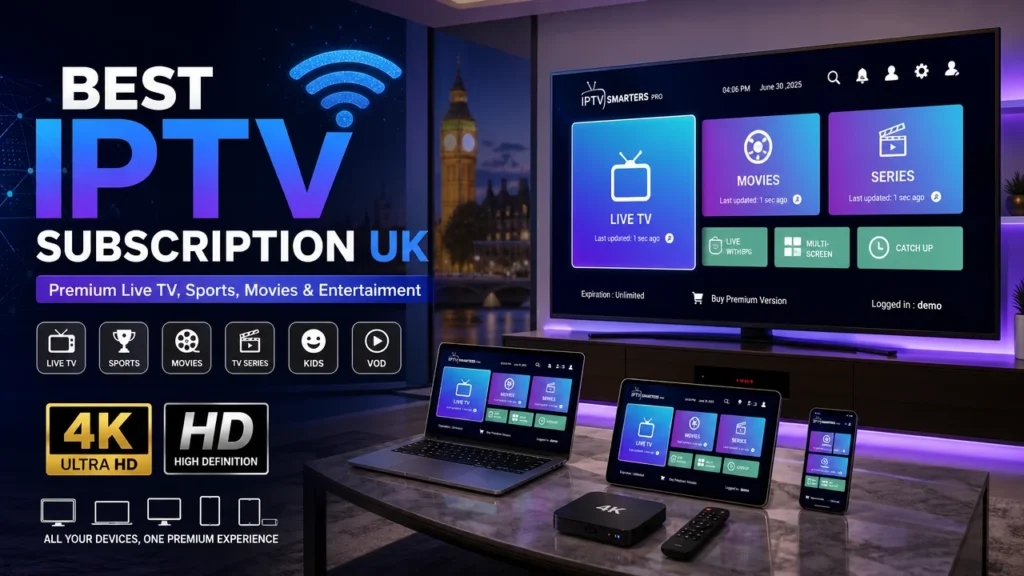
The entire process from unboxing to watching TV typically takes less than 15 minutes. The image below illustrates a typical setup configuration used by most cord-cutters today.
Concrete Benefits for Users
Why are millions of people worldwide switching to IPTV boxes? The advantages go far beyond simply cutting the cable cord:
- Massive channel selection: A single subscription often provides 5,000 to 20,000+ channels from dozens of countries — including local, regional, and international networks you can't get elsewhere.
- 4K and HDR streaming: Modern IPTV boxes support stunning picture quality with 4K resolution at 60 frames per second, HDR10+, and Dolby Vision for compatible content.
- No long-term contracts: Most premium IPTV services operate on a month-to-month basis. You can subscribe for one month and cancel anytime, with no cancellation fees or early termination penalties.
- Multi-device and multi-room support: Many subscriptions allow streaming on 2 to 5 devices simultaneously, meaning one account covers TVs in your living room, bedroom, and even your phone while traveling.
- Backward compatibility: IPTV boxes work with older TVs via HDMI adapters, making them a practical upgrade for any television set.
- Integrated streaming apps: Besides IPTV, you can install Netflix, YouTube, Spotify, Kodi, Plex, and thousands of other Android apps — replacing multiple devices with one box.
Honest Limitations You Should Consider
Pros
- Vast channel library (thousands of channels)
- Extremely affordable vs. cable ($10-$25/month)
- 4K UHD and HDR picture quality
- No long-term contracts required
- Multi-device streaming included
- Works with all major IPTV apps
Cons
- Requires stable high-speed internet (25Mbps+ for 4K)
- Some providers have unreliable uptime (server downtime)
- Legal gray area for certain unverified services
- EPG (electronic program guide) can sometimes be delayed
- Initial setup can confuse non-tech-savvy users
- Box quality varies widely between brands
IPTV Box vs. Firestick vs. Smart TV: Comparison
Many people ask whether they should buy a dedicated IPTV box, an Amazon Firestick, or just rely on their smart TV. Each has distinct advantages depending on your priorities. Here's a side-by-side breakdown:
| Feature | IPTV Box (Dedicated) | Amazon Fire Stick | Smart TV (Built-in) |
|---|---|---|---|
| Price (hardware) | $40 - $120 | $30 - $60 | $0 (built-in) |
| Performance | Excellent (4GB RAM, fast CPU) | Good (1.7GB-2GB RAM) | Varies widely, often slower |
| Channel Capacity | 5,000 - 20,000+ channels | Same via IPTV apps | Limited to app store offerings |
| 4K Support | Yes (60fps, HDR10+) | Yes (limited models) | Yes (newer models) |
| Storage | 8GB - 64GB expandable | 8GB (non-expandable) | 4GB - 16GB (varies) |
| Ethernet Port | Yes (gigabit) | No (adapter needed) | Yes (on most) |
| USB Ports | Yes (2-4 ports) | No (micro-USB only) | Yes (1-2 ports) |
| Ease of Setup | Moderate | Easy | Easiest |
As the table shows, dedicated IPTV boxes outperform both Fire Sticks and smart TVs in raw power and flexibility — especially if you want smooth 4K streaming, multiple USB connections, or expandable storage. A Fire Stick is more portable and easier to set up, but you'll sacrifice Ethernet connectivity and local storage. Smart TVs are fine for casual streaming but often struggle with IPTV app compatibility and performance under heavy loads.
Who Is an IPTV Box For?
Not everyone needs an IPTV box. Here are the specific user profiles that benefit most from this technology:
- The cord-cutter: You're tired of paying $150+ per month for cable and want to reduce your TV bill to $20-$30 while keeping access to your favorite channels.
- The sports enthusiast: You need reliable access to live NFL, NBA, Premier League, UFC, and international sports events without regional blackouts or geo-restrictions.
- The expat or international viewer: You want access to channels from your home country — whether that's Indian, Filipino, Turkish, Arabic, or European content — that local cable providers simply don't offer.
- The multi-TV household: You have multiple televisions and want a consistent viewing experience across all of them without paying for separate cable boxes at each TV.
- The tech-savvy user: You enjoy customizing your entertainment setup, installing third-party apps, and optimizing your streaming experience beyond what a standard smart TV allows.
Conversely, if you only watch Netflix, Hulu, and Disney+, and you're happy with your current smart TV or streaming stick, you probably don't need a dedicated IPTV box.
How to Get Started: Practical Numbered Steps
Ready to get your own IPTV setup running? Follow these seven proven steps to go from zero to streaming in under 30 minutes:
- Choose your IPTV box hardware: Select a box with at least 2GB RAM, 16GB storage, Wi-Fi 6 (or at least dual-band 5GHz), and hardware decoding for HEVC/H.265 codecs. Popular options include the Formuler Z11 Pro, BuzzTV XRS4900, and generic Android TV boxes like the Xiaomi Mi Box S or Nvidia Shield TV.
- Purchase a reliable IPTV subscription: We recommend clicking the secure subscription link here to access a verified provider with 99.5% uptime, 4K streaming, and no-contract monthly plans starting under $12. Avoid free trials from unknown sources — they often disappear or compromise your device.
- Connect and power up your box: Plug the HDMI cable into your TV, connect the power adapter, and press the power button. Your TV should display the boot screen within 30 seconds.
- Connect to the internet: Use an Ethernet cable for the most stable connection (recommended for 4K streaming). If using Wi-Fi, connect to your 5GHz network through the Settings menu.
- Install an IPTV player app: Open the Google Play Store (or download an APK), search for TiviMate or IPTV Smarters Pro, and install it. TiviMate is widely considered the best player due to its clean interface, EPG integration, and parental controls.
- Enter your subscription credentials: Open the player, select "Add Playlist," and enter the URL, username, and password your provider emailed you. Most providers also send an EPG URL for channel guides.
- Enjoy and customize: Spend 10 minutes browsing channels, setting up your favorites list, adjusting video output to 4K (if available), and configuring the EPG. You're now ready to watch thousands of live channels.
Frequently Asked Questions
Is an IPTV box legal to use?
The device itself is completely legal — IPTV boxes are simply Android or Linux computers designed for streaming. However, the legality depends entirely on the subscription service you use. Services that carry licensed content with proper agreements are legal. Unverified services that offer premium channels (like HBO, Sky Sports, or Disney+) without authorization operate in a legal gray area and may violate copyright laws. Always research your provider and choose one that is transparent about their content licensing.
What is the best IPTV box for live sports streaming?
For live sports, you need a box with strong processing power and reliable network connectivity. The Formuler Z11 Pro is often considered the best for sports because of its MyTVOnline 3 app, which offers extremely fast channel switching (under 1 second) and excellent buffer management for high-bitrate sports streams. The BuzzTV XRS4900 is another excellent choice with its integrated BuzzTV 5 OS that prioritizes live TV performance. Both support 4K at 60fps and have gigabit Ethernet ports for stable connections during big games.
How do I set up an IPTV box for the first time?
Setting up an IPTV box involves six simple steps: connect the box to your TV via HDMI and power it on, connect to your home network (Ethernet preferred), install an IPTV player app like TiviMate from the Google Play Store, obtain your subscription credentials (portal URL/username/password) from your IPTV provider, enter these credentials into the player app, and then wait for the channel list and EPG to load. Most first-time setups complete in 15-20 minutes, including app installation and initial configuration.
IPTV box vs Firestick: which is better for streaming?
A dedicated IPTV box is better for heavy IPTV streaming because it offers more RAM (2-4GB vs 1.5-2GB), built-in Ethernet ports for stable wired connections, USB ports for external storage or accessories, and better thermal management during long streaming sessions. Firesticks are better for casual users who prioritize portability and an easier initial setup. If you plan to watch live TV or 4K content for several hours daily, a dedicated IPTV box is the superior choice for performance and reliability.
Where can I buy an IPTV box subscription with no contract?
Many premium IPTV services now offer no-contract, month-to-month subscriptions that you can cancel anytime with no fees. You can find verified no-contract subscriptions through this secure platform which vets all providers for uptime, channel availability, and customer support. Look specifically for plans labeled "monthly" or "flexible" — these typically start at $10-$15 per month and include access to 5,000+ channels with no annual commitment.
What is the cheapest IPTV box with built-in Wi-Fi?
The cheapest reliable IPTV box with built-in Wi-Fi is typically the Xiaomi Mi Box S, which costs around $55-$65 and includes dual-band 802.11ac Wi-Fi, 2GB RAM, 8GB storage, and Android TV 9.0 with Google Play Store access. For an even cheaper option, generic Android TV boxes from brands like Tx6 or H96 can be found for $30-$40, but these often have inferior Wi-Fi performance, slower processors, and minimal customer support. We recommend spending at least $50 to get a device with reliable Wi-Fi and proper certification.
Can I use one IPTV box for multiple TVs in my house?
An IPTV box connects to one TV via HDMI, so each television requires its own box. However, you can use a single IPTV subscription across multiple boxes if your provider allows multi-room streaming — most premium providers support 2-5 simultaneous connections. Simply purchase an IPTV box for each TV, install the same IPTV player app on all of them, and log in using the same subscription credentials. This setup allows each TV to show different channels independently, making it perfect for households where family members want to watch different content simultaneously.
What features should I look for in a 4K IPTV box review?
When reading 4K IPTV box reviews, prioritize these critical features: CPU model and clock speed (Amlogic S905X4 or better is ideal), RAM capacity (minimum 2GB for smooth 4K playback), storage space and microSD expandability, HEVC/H.265 hardware decoding support (essential for 4K streams), HDMI 2.1 or 2.0b output for proper 4K at 60fps, Wi-Fi standard (Wi-Fi 6 is best, 802.11ac is acceptable), and Ethernet port speed (gigabit preferred). Also check for Dolby Vision and HDR10+ support if you have a compatible TV. Avoid boxes that claim 4K support but lack HEVC decoding — they will buffer constantly.
Ready to Take the Next Step?
By now, you have a complete understanding of what an IPTV box is, how it works, how it compares to alternatives like Firesticks and smart TVs, and exactly how to set one up for your home. The technology has matured significantly over the past three years, and with the right hardware and a reliable subscription, you can replace a $200 monthly cable bill with a $15-$25 IPTV plan that offers more channels, better flexibility, and no long-term commitment.
The most important decision you'll make is choosing a trustworthy IPTV provider. Hardware can be replaced easily — but a poor subscription service will ruin the experience with constant buffering, missing channels, and unreliable uptime. That's why we recommend starting with a verified subscription platform that screens providers for performance, legal compliance, and customer satisfaction.
Secure special promotional rates instantly before the window closes.
Activate Your iptv box Subscription Now →Final Thoughts
Cutting the cord with an IPTV box is one of the smartest entertainment decisions you can make in 2026 — but only if you approach it with the right information and a quality provider. This guide has walked you through the hardware, the setup process, the real-world pros and cons, and exactly who benefits most from this technology.
Remember these key takeaways: invest in a quality box with at least 2GB RAM and an Ethernet port, choose a subscription provider with proven uptime and responsive support, and take advantage of month-to-month plans so you're never locked into a bad service. Whether you're watching Premier League matches in 4K, catching up on Turkish dramas, or giving your parents access to international news channels, an IPTV box delivers unmatched value when set up correctly.
If you're ready to begin, we recommend starting with a verified subscription here — the promotional pricing window is limited, and the service includes multi-device support, 4K streaming, and 24/7 technical assistance. Your cable-free entertainment setup is just one click away.